
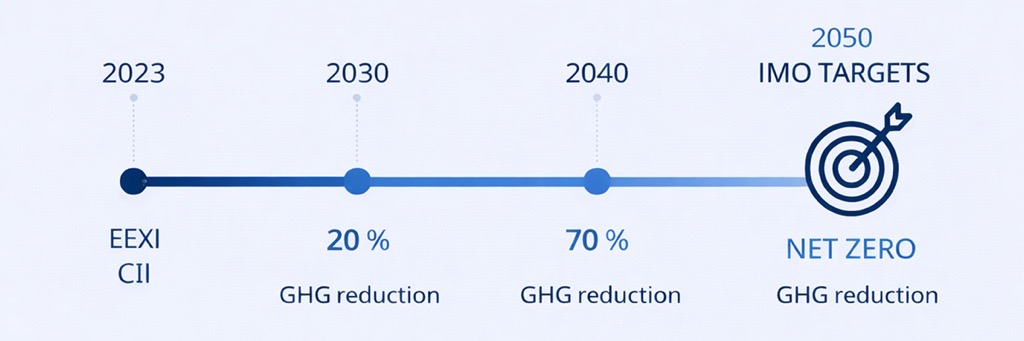
The regulatory framework governing vessel emissions and energy efficiency continues to tighten. Carbon Intensity Indicator (CII) reference lines are scheduled to become increasingly stringent, while the IMO's revised GHG Strategy introduces progressively demanding decarbonisation targets towards 2050. Additional regulatory mechanisms, including EU ETS and FuelEU Maritime, further increase the operational and financial implications of vessel efficiency performance.
Under these conditions, maintaining compliance requires a structured evaluation of vessel performance, technical limitations, and available improvement measures. Reactive implementation of isolated technologies is unlikely to deliver optimal outcomes from either a compliance or investment perspective.
The foundation of any decarbonisation strategy is a comprehensive assessment of current vessel performance.
Key parameters typically include:
The objective is to quantify performance losses, identify efficiency gaps, and establish a technical basis for evaluating improvement measures.
Following baseline assessment, potential efficiency improvements should be evaluated using a combination of engineering analysis, operational modelling, and economic assessment.
Operational and maintenance-related measures generally represent the first stage of optimisation and may include:
Where additional reductions are required, propulsion and hydrodynamic improvements may be assessed, including:
For vessels requiring more substantial emissions reductions, further evaluation may be conducted for technologies such as:
The technical and economic viability of these solutions depends on vessel characteristics, operational profile, remaining service life, and regulatory exposure.
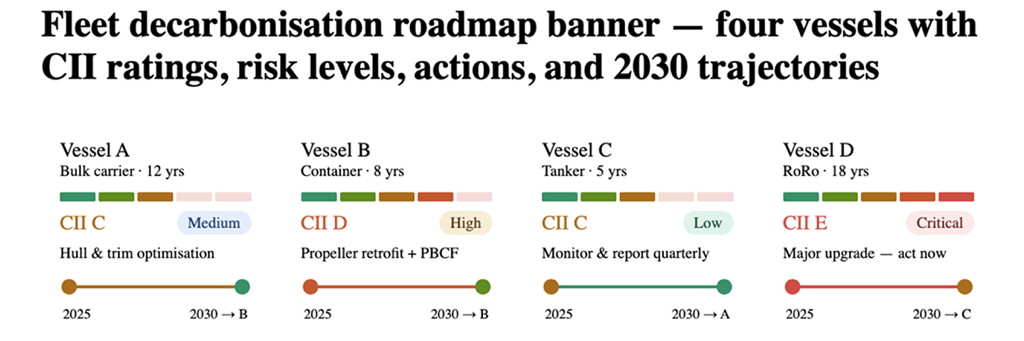
Fleet-wide standardisation of decarbonisation measures frequently results in suboptimal investment decisions. Vessel age, design characteristics, trading patterns, charter requirements, and regulatory exposure vary significantly across fleets.
Consequently, compliance planning should be performed at vessel level, incorporating:
The outcome should be a prioritised implementation roadmap that aligns technical improvements with regulatory milestones and operational requirements.
GLO Marine provides engineering and project delivery services supporting vessel energy efficiency improvements, regulatory compliance, and decarbonisation initiatives.
Our services include:
Our engineering teams evaluate available technologies and retrofit solutions based on vessel-specific operational, technical, and commercial requirements. Services are delivered from initial feasibility assessment through detailed engineering, procurement support, installation management, and post-retrofit performance validation.
This approach enables shipowners and operators to establish technically justified compliance strategies, optimise capital allocation, and maintain operational competitiveness under increasingly demanding environmental regulations.
Assess current and projected CII performance, identify the most effective efficiency measures, and develop a vessel-specific implementation strategy aligned with regulatory requirements, operational objectives, and investment priorities.


