
Over the last several years, we have collaborated with shipowners operating across multiple vessel segments and trading patterns. While EEXI requirements may initially seem straightforward from a regulatory perspective, the practical implications onboard tell a very different story. Discussions today are increasingly centered around operational flexibility, technical reliability, and maintaining commercial performance — not simply obtaining approval certificates.
The Energy Efficiency Existing Ship Index (EEXI) has now become an established benchmark throughout the maritime industry. Whereas the Carbon Intensity Indicator (CII) evaluates a vessel’s operational emissions annually, EEXI assesses the ship’s inherent technical efficiency based on design characteristics and installed propulsion power.
For most operators, achieving certification was only the first phase. As the industry progresses through 2026, attention is moving toward understanding the long-term operational consequences of the chosen compliance strategy.
EEXI applies to the majority of ships above 400 GT operating under MARPOL Annex VI and measures the vessel’s theoretical CO₂ emissions relative to transport work.
The regulation was introduced to align existing tonnage more closely with the efficiency expectations already imposed on newbuild vessels through EEDI standards. For many aging fleets, reaching the required thresholds required more than administrative adjustments and often involved significant technical modifications.
As a result, shipowners were faced with a critical choice between rapid compliance solutions and investments aimed at preserving long-term vessel performance.
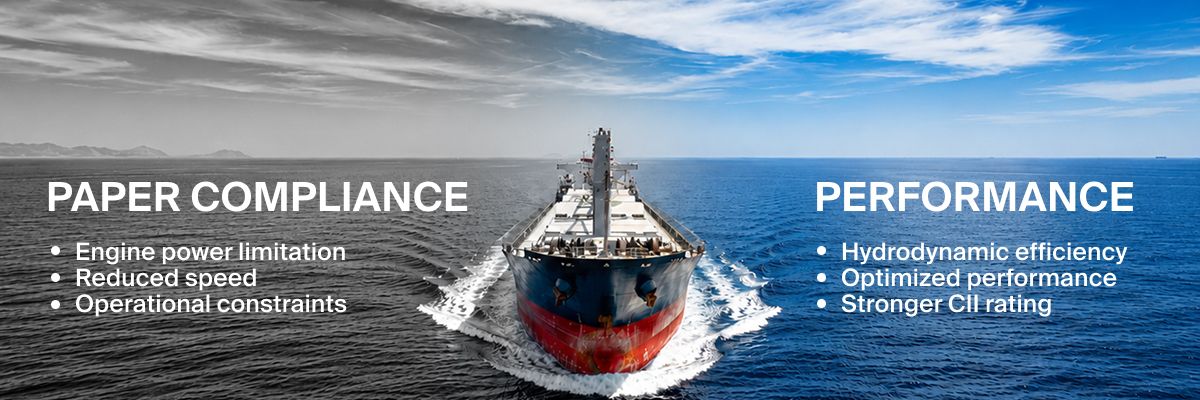
To secure compliance within limited timelines, much of the industry adopted Engine Power Limitation (EPL) or Shaft Power Limitation (ShaPoLi) systems. Although these measures offer a relatively economical route to compliance, they also introduce operational compromises.
Limiting available engine output can reduce a vessel’s performance margin during adverse weather conditions, heavy seas, or complex maneuvering operations. From a commercial standpoint, reduced speed capability may also impact charter opportunities, especially in trades where schedule reliability remains essential.
While regulations permit temporary override of the power restriction for safety purposes, every activation requires documentation and reporting to the relevant administration, increasing regulatory visibility and operational scrutiny.
For shipowners seeking to maintain both compliance and commercial flexibility, relying solely on power limitation is rarely considered a sustainable long-term approach.
Rather than focusing only on limiting power, many owners are now investing in solutions that improve the vessel’s overall hydrodynamic and propulsion efficiency.
Technologies such as Mewis ducts, pre-swirl devices, optimized propeller designs, and advanced hull coatings contribute directly to reducing fuel consumption and improving overall energy performance. These upgrades not only support EEXI compliance but also create measurable benefits for ongoing CII performance.
At the same time, fuel transition strategies are becoming increasingly important. The adoption of lower-carbon fuel alternatives can significantly improve emissions profiles and support future environmental targets.
The industry is gradually moving away from minimum-threshold compliance and toward broader efficiency optimization strategies that protect both operational capability and asset value.
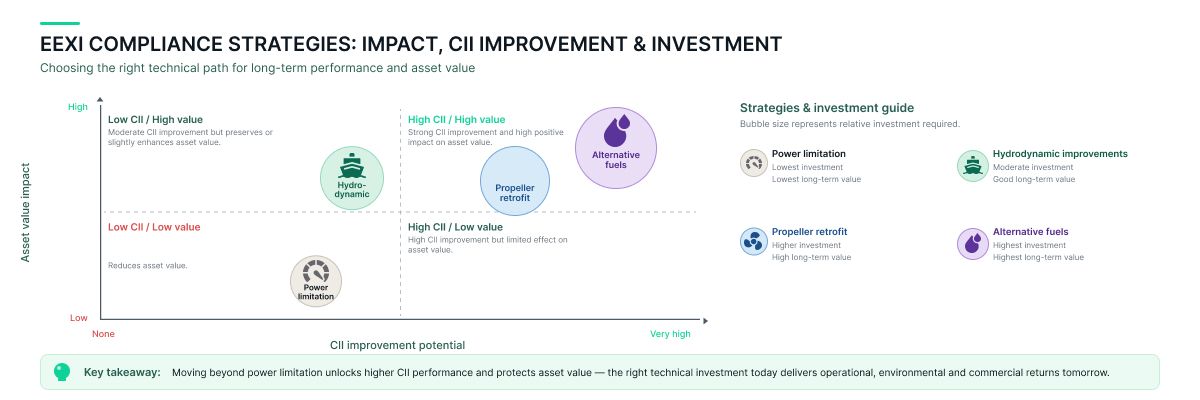
Treating EEXI and CII as independent requirements can create long-term operational challenges.
A vessel that barely satisfies EEXI requirements through aggressive engine limitation may still struggle to maintain favorable CII ratings over time. In contrast, ships that underwent efficiency-focused retrofits are generally better positioned to sustain operational performance while meeting evolving environmental targets.
In many respects, EEXI defines the technical starting point, while CII measures how effectively the vessel performs in real operational conditions.
If the vessel’s hull form, propulsion system, or energy efficiency remains suboptimal, operational measures alone will have limited impact on long-term emissions performance. This is why technically optimized vessels are increasingly demonstrating stronger resilience in today’s market.
Shipowners continue to encounter several technical and commercial challenges as regulations evolve:
These factors are driving the industry toward more comprehensive engineering-based solutions.
EEXI should no longer be viewed simply as a regulatory milestone. It has become an important indicator of a vessel’s long-term operational readiness and future competitiveness.
At GLO Marine, we assist shipowners in developing practical and technically sound strategies that go beyond basic compliance requirements.
Our support includes:
Our focus remains on delivering engineering solutions that not only satisfy regulatory requirements, but also strengthen fleet efficiency, operational reliability, and long-term commercial performance.
Discuss your vessel’s EEXI strategy with GLO Marine and explore practical solutions to improve efficiency, maintain operational flexibility, and support long-term CII performance.


