
Shipping companies worldwide are racing against time to meet decarbonization targets and comply with the IMO’s CII framework. One of the most promising retrofit technologies leading this transformation is the Air Lubrication System (ALS). Already installed on a wide range of vessels, from cruise ships and LNG carriers to container vessels and ro-ro ships, ALS technology consistently demonstrates fuel savings of 5–10%, reduced CO₂ emissions, and lower maintenance costs thanks to decreased hull friction and biofouling.
The shipping industry faces increasing pressure to cut greenhouse gas emissions and reduce operational costs while maintaining competitiveness. ALS technology directly addresses these needs by enhancing energy efficiency and ensuring regulatory compliance across different vessel types and trading routes.
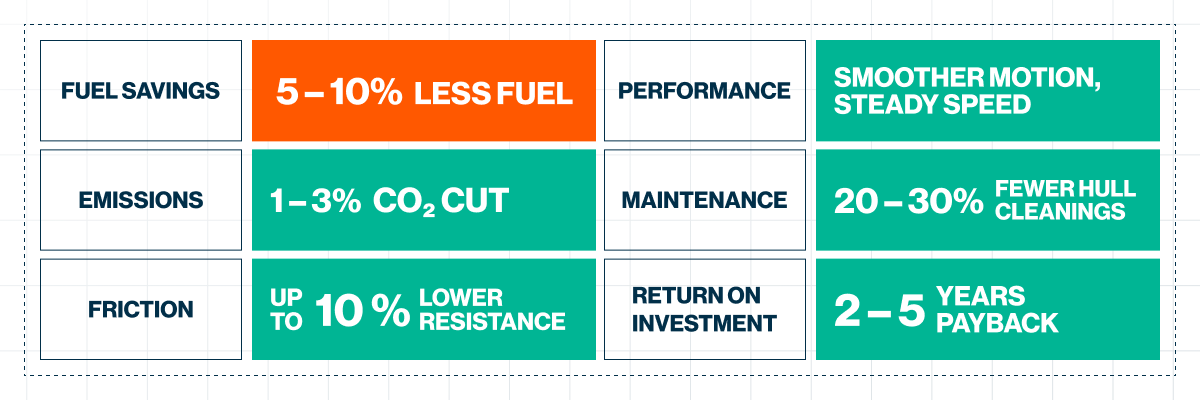
By reducing friction between the hull and seawater, vessels maintain service speed with less engine power. Depending on the vessel type and operating profile, operators typically achieve fuel savings of 5–10%, which translates into substantial OPEX reductions across the fleet.
Lower fuel consumption directly reduces CO₂ emissions. Many ALS installations report 1–3%+ carbon reductions, contributing to IMO 2030 and CII compliance while strengthening sustainability credentials in a market increasingly driven by ESG factors.
Air bubbles form a protective layer between the hull and seawater, significantly reducing corrosion and biofouling. This lowers the frequency of dry-dock maintenance, extends hull coating lifespans, and improves vessel availability.
While ALS requires upfront CAPEX, the combination of long-term fuel savings, reduced maintenance, and avoidance of non-compliance penalties delivers a compelling ROI for shipowners and fleet managers.
Not all ALS solutions are equal. Providers differ in design approach, energy demand, sensitivity to sea states, and resilience to minor groundings. Choosing the right system depends heavily on vessel type, operating speed, and draft.
At GLO Marine, we provide end-to-end solutions, including engineering guidance to help owners evaluate options and select the most suitable ALS technology for their fleet profile and operational requirements.
Successful ALS implementation goes beyond choosing a vendor. It requires careful vessel modifications across multiple disciplines:
These adjustments require a coordinated, multidisciplinary approach to safeguard vessel integrity and guarantee maximum efficiency.
With global experience in ship retrofits and decarbonization technologies, GLO Marine brings together its hull, piping, electrical, automation, and commissioning teams to deliver seamless ALS retrofit projects. From feasibility studies and engineering design to installation support and commissioning, we ensure every ALS installation achieves its promised performance and contributes to sustainable shipping.
As regulators tighten emissions requirements and fuel costs remain volatile, ALS offers a proven, scalable pathway for shipowners looking to boost competitiveness while aligning with decarbonization goals.
At GLO Marine, we don’t just deliver engineering—we deliver confidence in performance, compliance, and ROI.
Discover how the decarbonisation plan developed by GLO Marine, can help you navigate regulatory challenges, reduce emissions, and turn compliance into a competitive edge. Explore the full details here and start charting your roadmap to a greener future today.


